Every freeway is a highway, but not every highway is a freeway. “Highway” is the broad category covering all major roads. A freeway is a specific type: a divided highway with full control of access, meaning you can only get on or off via ramps, and nothing crosses it at grade — no traffic lights, no stop signs, no driveways, no railroad crossings.
That’s the whole distinction. Everything else people argue about — speed limits, lane counts, whether it’s called an interstate — is regional habit rather than definition.
Key Takeaways
- Highway = umbrella term for major roads. Freeway = a divided highway with full control of access.
- Expressway sits between them: a divided highway with partial control of access, so it may still have some intersections or crossings.
- Full control of access means every entry and exit uses a ramp and all crossings are grade-separated.
- The terminology is regional. Californians say “freeway” for roads that Midwesterners call “expressways” and East Coasters call “highways.”
The Technical Definitions
Transportation engineering uses precise language here. The Federal Highway Administration groups both freeways and expressways into a single functional class — “Other Freeways and Expressways” — describing them as routes whose directional travel lanes are usually separated by a physical barrier, with access points limited primarily to on- and off-ramps at grade-separated interchanges, or a very limited number of at-grade intersections (FHWA Highway Functional Classification).
Highway. The general term. It covers freeways, expressways, arterials, and rural through-routes. A two-lane road through farmland with driveways along it is a highway.
Freeway. A divided highway with full control of access. Every entry and exit point is a ramp. Every crossing road passes over or under. No signals, no at-grade intersections, no direct property access.
Expressway. A divided highway with partial control of access. It looks freeway-like — divided, high-speed, limited entry points — but may retain some at-grade intersections, signals, or crossings.
Highway vs. Freeway vs. Expressway
| Feature | Highway (general) | Expressway | Freeway |
|---|---|---|---|
| Access control | Varies, often none | Partial | Full |
| Divided by median or barrier | Sometimes | Yes | Yes |
| Traffic signals on the mainline | Possible | Possible | No |
| At-grade intersections | Possible | Possible | No |
| Driveways and property access | Possible | Limited | No |
| Entry and exit | Anywhere | Ramps + some intersections | Ramps only |
| Pedestrians and bicycles | Often allowed | Sometimes restricted | Generally prohibited |
What “Control of Access” Actually Means
This is the concept the whole distinction rests on, and it’s simpler than the terminology suggests.
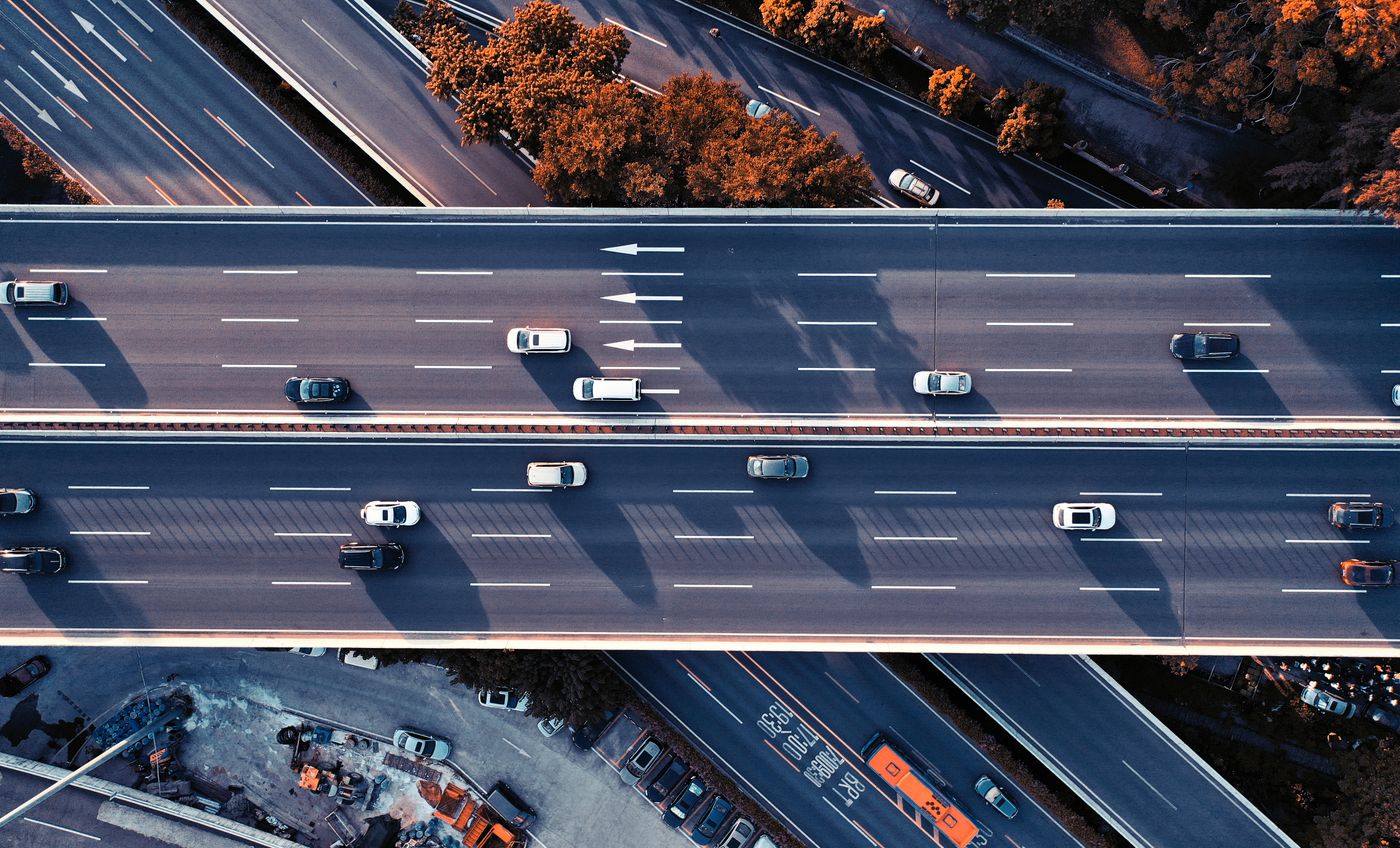
Full control of access means the road’s mainline is completely separated from everything around it. Every on-ramp merges from a lane that runs alongside the traffic flow. Every off-ramp diverges the same way. Every crossing road goes over a bridge or under an underpass — never across.
The practical consequence is that nothing on a freeway ever crosses your path perpendicularly. No car pulls out of a driveway in front of you. No cross traffic runs a light. That’s the entire safety argument for the design, and it’s why freeways carry the highest speed limits.
Partial control of access means most of that is true, but not all of it. An expressway might be divided and ramp-fed for miles, then hit a signalized intersection with a rural crossroad. It’s the compromise design — most of the throughput benefit at a fraction of the construction cost of full grade separation.
Why Californians Say “Freeway” for Everything
Regional vocabulary diverged decades ago, and it confuses people who move between regions.
California uses “freeway” almost exclusively, and locals attach “the” to route numbers — the 5, the 805, the 163. The state built out a genuinely enormous grade-separated network early, so the word fit almost everything.
The Northeast leans on “highway,” “turnpike,” and “parkway.” A parkway historically meant a scenic route with commercial trucks banned — a restriction still enforced on several of them.
The Midwest and South use “expressway” and “interstate” more freely, often for roads that meet the full freeway definition.
“Interstate” is a funding and numbering designation, not a design category. Interstates are built to freeway standards, but plenty of freeways aren’t interstates — California’s state routes include many fully access-controlled freeways with no interstate shield.
None of this changes what the road is. It changes what people call it.
Does the Difference Affect You as a Driver?
In three practical ways.
Merging. On a freeway you’re always merging from an acceleration lane into moving traffic at speed. On an expressway you may face an actual intersection with cross traffic. The failure modes are different, and so is the attention they demand.
What’s legal on the road. Freeways generally prohibit pedestrians, bicycles, and slow vehicles. Expressways and general highways often permit them, which is exactly the situation that produces the worst outcomes when a driver isn’t expecting it.
Collision type. Freeway crashes tend toward rear-end and sideswipe incidents at higher speeds, since without cross traffic there is no T-bone geometry. Expressways and undivided highways add intersection and head-on collision risk. Different crash types produce different damage patterns, which is why post-collision structural measurement matters regardless of how minor the impact looked. Our collision repair services include factory-spec measurement for exactly that reason.
Frequently Asked Questions
Is an interstate the same as a freeway?
Not quite. “Interstate” refers to the federally funded numbered highway system. Interstates are built to freeway standards, so virtually every interstate is a freeway — a small number of legacy segments do retain at-grade intersections. Many freeways, meanwhile, are state routes with no interstate designation. In California, roads like SR-163 are full freeways without being interstates.
What’s the difference between a freeway and an expressway?
Access control. A freeway has full control of access — every entry and exit is a ramp, and all crossings are grade-separated. An expressway has partial control, so it may still have occasional at-grade intersections or signals despite otherwise looking similar.
Can you walk or bike on a highway?
On many general highways, yes. On freeways, generally no — pedestrians, bicycles, and vehicles unable to maintain minimum speeds are typically prohibited. Rules vary by state and by specific route, so check local law rather than assuming.
Why does California call them freeways instead of highways?
Regional convention rooted in the state’s early and extensive build-out of fully grade-separated roads. The term “freeway” refers to being free of cross traffic and intersections, not free of tolls — although most California freeways happen to be toll-free.
Is a turnpike a freeway?
Usually yes in design terms — most turnpikes are fully access-controlled divided highways. “Turnpike” describes the funding model (a toll road), not the engineering. A road can be a freeway and a turnpike at the same time.
The Bottom Line
A freeway is a highway with full control of access: ramps only, no intersections, no signals, no driveways. An expressway has partial control. “Highway” is the umbrella term for all of it.
The engineering distinction is precise; the everyday vocabulary is regional. If you moved to San Diego and everyone around you says “take the 8,” they mean a freeway — and they’re using the term correctly.
Spend enough time on either and you’ll eventually need a tire changed on the shoulder. Our guide to how long a tire change actually takes covers when to do it yourself and when to stay in the car and call for help.