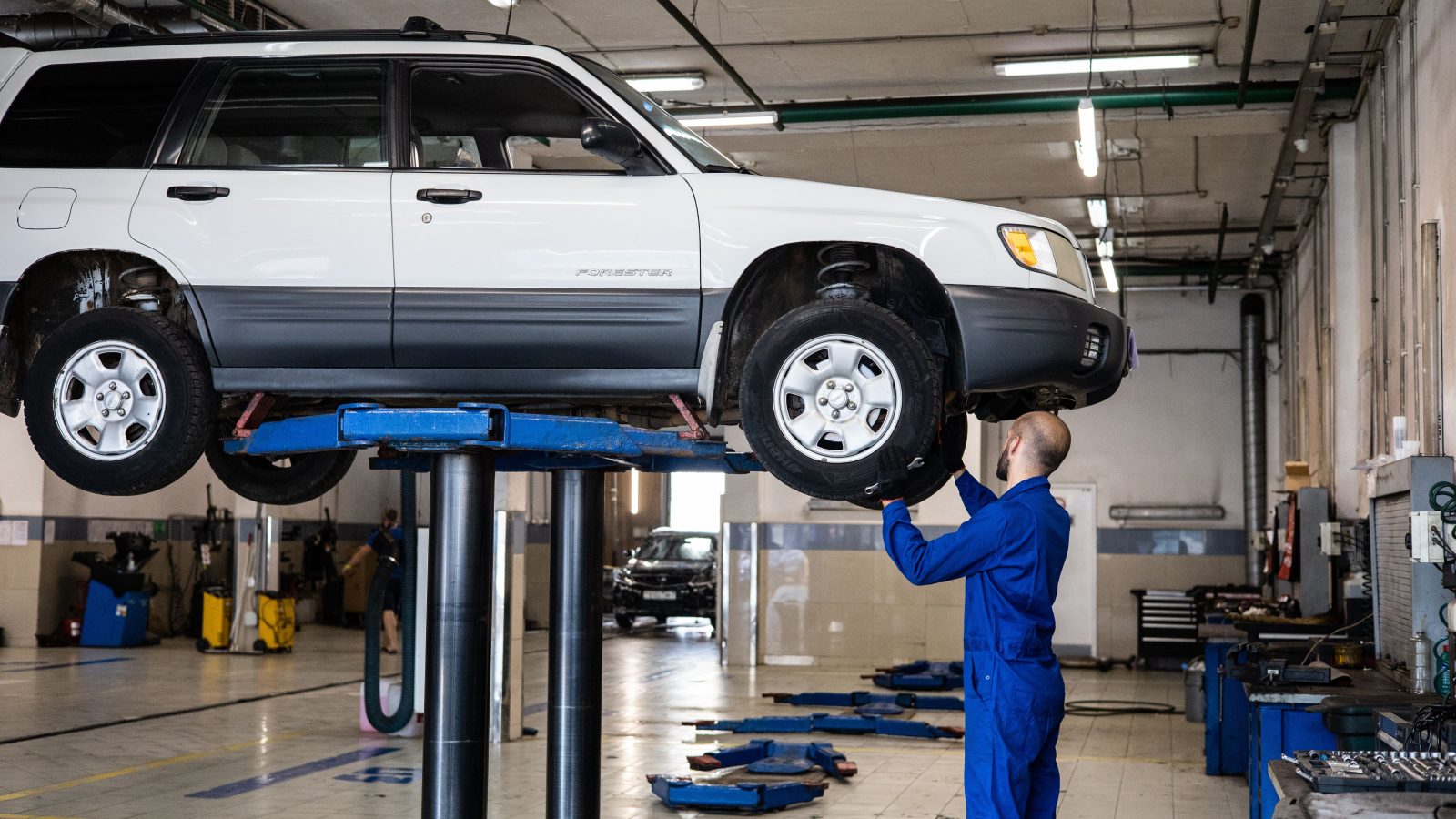
Control arm replacement costs $250 to $650 per side for most vehicles, with SUVs and crossovers on the higher end sometimes running $800-$1,100. The part itself is $60-$250 — most of the bill is 1-3 hours of labor, plus a required wheel alignment afterward that most quotes leave off the sticker price.
Here’s the full cost breakdown by vehicle type, the symptoms that point to a control arm rather than something else nearby, and what to know before deciding on DIY.
Key Takeaways
- Typical cost: $250-$650 per side for compact and mid-size vehicles; $800-$1,100+ on SUVs and crossovers with pricier parts.
- Always budget an alignment (~$100-$150) — replacing a control arm changes suspension geometry, same as a tie rod.
- Clunking over bumps, steering wander, and uneven tire wear are the core symptoms, with lower control arm failures usually more severe than upper.
- DIY is rated 6-8 out of 10 difficulty — harder than brakes or spark plugs, mainly due to seized hardware and getting the ball joint torque right.
Control Arm Replacement Cost by Vehicle Type
| Vehicle type | Typical cost per side | Notes |
|---|---|---|
| Compact FWD sedan (Civic, Corolla, Sentra) | $275-$475 | Cheapest and most common case |
| Mid-size sedan / general estimate | $250-$650 | National range across most control arm jobs |
| SUV / crossover (Pilot-class) | $800-$1,100+ | Pricier parts and sometimes more labor to access |
Figures compiled from 2026 cost guides (RepairPal; Detroit Axle; TheCostGuide, retrieved July 2026). Add $100-$150 for the required alignment on top of whatever the arm itself costs — it’s not optional, and skipping it wears out a new set of tires fast.
Signs Your Control Arm Is Failing
- Clunking or knocking over bumps, turns, or braking — worn joints let the arm move loosely before it “thunks” into place.
- Steering wander or looseness, with the car feeling less responsive or slow to react to input.
- Pulling to one side or the car not tracking straight, from the altered geometry a worn arm creates.
- Uneven tire wear, especially on the inner or outer edge of the tread.
- Vibration that gets worse over bumps or at speed.
Lower control arm failures tend to be the more obvious ones — severe clunking, real steering instability, noticeable vibration. Upper control arm failures are subtler: a slight pull to one side, minor wander, or tire wear that creeps up before anyone notices a noise (MOOG Parts). If the symptom is vague, that alone doesn’t rule out a control arm problem — it just means it might be a smaller failure so far.
Control Arm or Ball Joint — What’s Actually Failing?
These get confused because they’re physically connected, and the distinction changes your repair. On many modern cars, especially those with aluminum control arms, the ball joint is riveted or cast permanently into the arm — there’s nothing to replace separately, so the whole arm gets swapped even if only the joint has failed.
On some steel or cast control arms, the ball joint can be replaced on its own. But pressing a seized joint out often needs a specialty press or drilling out rivets, and if the bushings are also aging, you’re repeating most of the same labor a second time later anyway. That’s why many shops recommend replacing the full control arm assembly rather than chasing a cheaper ball-joint-only fix, once you’re already this deep into the suspension (1A Auto).
Is DIY Worth It?
It’s possible, but this sits well above beginner difficulty — 6-8 out of 10, harder than brakes or spark plugs and closer to a serious suspension job (VehicleRuns). The mechanical steps are manageable: jack, stands, disconnect the arm, install the new one. The real obstacles are corroded bolts that won’t budge, getting preload and torque right on reassembly, and not damaging the ball joint or bushings in the process.
Unlike a sway bar link, a control arm job also always needs an alignment afterward — the same requirement as a tie rod replacement, since you’re changing suspension geometry. Factor that $100-$150 into your DIY math even if you handle the wrench work yourself; it’s not something to skip regardless of who does the labor.
Frequently Asked Questions
Can I drive with a bad control arm?
Briefly and cautiously for a minor symptom, but not indefinitely. A control arm is a core suspension component — if it fails completely, you can lose control of that wheel’s alignment entirely. Clunking, wander, or a pull to one side should get inspected soon rather than monitored for months.
Do I need to replace both sides at once?
Not necessarily, but both arms see similar mileage and stress, so if one is failing the other is often not far behind. If a shop shows you measurable play on the healthy side too, replacing both saves a second labor charge down the road.
Why does a control arm job need an alignment?
The control arm helps set the wheel’s position relative to the body, so installing a new one shifts camber and sometimes toe from where they were with the worn part. Skipping the alignment wears the new tires unevenly within a few thousand miles — the same logic that applies to a tie rod job.
Is a control arm problem the same as a bad CV axle or engine mount?
They can produce similar-feeling symptoms but they’re different parts. A clunk specifically when turning points more toward a CV axle, while vibration that’s worse at idle and smooths out with speed usually means a bad engine mount. A shop inspection is the fastest way to sort out which suspension or drivetrain part is actually worn.
The Bottom Line
Budget $250-$650 per side for most vehicles, more on SUVs and crossovers, and always add $100-$150 for the alignment that has to follow. Clunking over bumps and vague, wandering steering are the signs worth acting on — and if you’re chasing the difference between this and a control-arm-adjacent problem, our tie rod replacement cost guide covers the steering-side sibling repair.
Not sure if it’s the control arm, a bushing, or the ball joint specifically? Contact San Diego Bumper and Collision for a suspension inspection before you order parts.