
Strut replacement costs $400 to $900 per axle installed — noticeably more than the $250-$600 per axle for standalone shocks — because a strut is a structural suspension part, not just a damper, and the job legally requires a wheel alignment afterward. Replace all four corners on a worn-out vehicle and the full bill can run $800 to $5,000, depending on your car and whether you go OEM or aftermarket.
This guide covers exactly what drives that price, how to tell struts from shocks, the bounce test that catches worn struts before they get dangerous, and why this is one suspension job most DIYers should think twice about.
Key Takeaways
- Struts cost 20-40% more than shocks — $400-$900 per axle vs. $250-$600 — because they’re structural and always need an alignment.
- Most struts last 50,000-100,000 miles, but severe symptoms mean replacing them within days, not months.
- Worn struts measurably increase stopping distance — roughly 23% longer at 50% shock efficiency, about 21 extra feet at 31 mph.
- DIY strut work is genuinely dangerous — the coil spring holds 1,000-1,500 lbs of compressed force even off the car, and improper removal can cause serious injury.
What’s the Difference Between Struts and Shocks?
These terms get used interchangeably, but they’re different parts with different jobs — and that difference is exactly why struts cost more to replace.
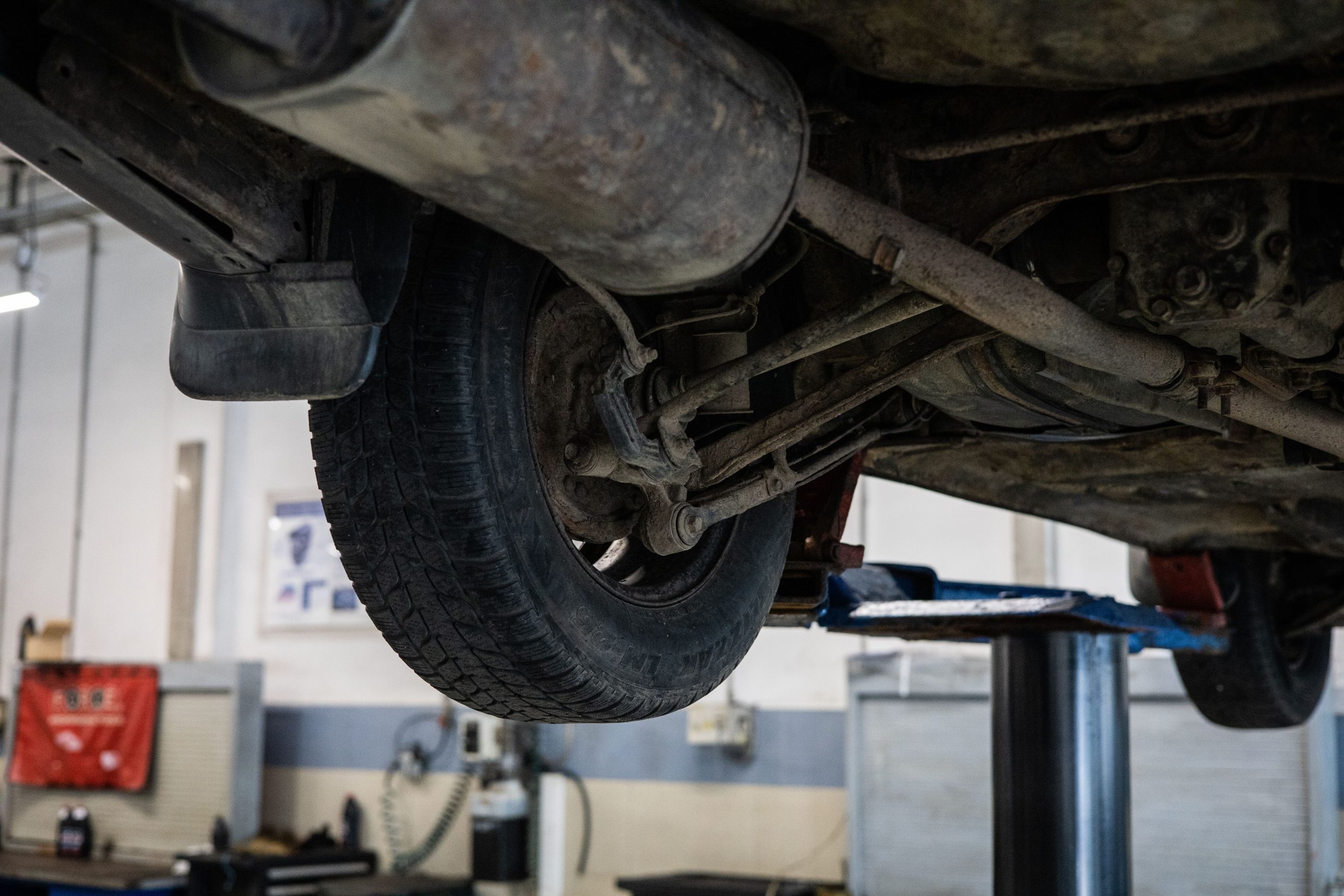
A shock absorber is a standalone damping component. It controls how the suspension moves but doesn’t support the car’s weight or hold the wheel in position — other parts (control arms, springs) handle that job. A strut does both at once: it’s a damper built into a structural assembly that also carries the coil spring and helps locate the wheel. Pull a strut off the car and you’re removing a load-bearing part of the suspension, not just a comfort component.
That structural role is also why struts affect alignment settings and shocks don’t. Most modern cars use struts up front (a MacPherson strut design) and either struts or shocks in the rear, depending on the platform (O’Reilly Auto Parts).

Strut Replacement Cost Breakdown
| Job scope | Typical cost | Notes |
|---|---|---|
| Shocks, per axle | $250-$600 | No alignment required |
| Struts, per axle | $400-$900 | Parts $150-$400, labor $200-$500, includes alignment |
| All four corners (struts) | $800-$5,000 | Full range across vehicle types and part quality |
Figures compiled from 2026 cost guides (RepairPal; CarParts.com; SoFi, retrieved July 2026). Most shops charge $80-$120 for the required four-wheel alignment and bundle it directly into the strut quote rather than listing it separately — worth asking about if a quote looks unusually low.
Why Struts Cost More Than Shocks
Three things stack up: the part, the labor, and the mandatory alignment. Strut assemblies cost more to manufacture since they combine the damper, spring perch, and often the mount into one unit. Labor runs higher too — struts are more involved to remove and reinstall correctly, especially on vehicles where the strut mounts up into the body structure itself.
Then there’s the alignment, which shocks simply don’t require. Because a strut helps set the wheel’s position, swapping it changes camber and sometimes caster enough that skipping the alignment leads to uneven tire wear within a few thousand miles — the same logic that applies to a control arm or tie rod replacement. Add it up and struts run 20-40% more than shocks for what looks like a similar repair (LUFT-MEISTER).
Signs You Need New Struts
- Bouncing after a bump. A healthy suspension settles almost immediately; worn struts let the car bounce two or three times before it stops, like a boat in choppy water.
- Nose-diving under hard braking. Worn front struts can’t resist the forward weight transfer during braking, so the front end dips sharply.
- Excessive body roll in turns, as the struts lose their ability to control body movement.
- Clunking over bumps, though this symptom overlaps with other worn suspension parts and isn’t struts-specific on its own.
- Uneven or cupped tire wear, from the tire losing consistent contact with the road as the strut loses damping control.
The bounce test is the simplest DIY check: push down hard on each corner of the car and release. Two or more bounces before the car settles means the strut or shock at that corner is worn beyond safe operation (Monroe Shocks & Struts).
Why Nose-Diving Is More Than a Comfort Issue
Worn struts don’t just make for a mushier ride — they measurably increase how far it takes to stop. At around 50% shock efficiency, stopping distance increases by roughly 23%, which works out to about 21 additional feet at 31 mph (Car Care Total). That’s the length of a mid-size car — the difference between stopping in time and not.
How Long Do Struts Last?
Most struts last 50,000 to 100,000 miles, depending on driving habits, road conditions, and vehicle weight (Maxi’s Mechanics). Rough roads, heavy loads, and aggressive driving all shorten that window, while highway-heavy commuting on smooth roads stretches it.
You can technically keep driving for weeks or months after struts start feeling soft, but the safety math changes once symptoms turn severe — bottoming out, real bouncing, or noticeably longer stopping distances. At that point, treat it as a fix within days, not months situation rather than routine deferred maintenance.
Should You Replace Struts in Pairs?
Yes, as a rule. Front struts wear at close to the same rate since they carry similar load and see identical road input, and mismatched damping side-to-side can make the car handle unpredictably — especially under hard braking or in a panic swerve. Most shops recommend replacing both fronts (or both rears) together even if only one side is showing symptoms yet.
Is DIY Worth It?
This is the one suspension job on our site where the honest answer leans toward “leave it to a shop” for most drivers — and it’s not about difficulty alone. It’s about what happens if it goes wrong.
The coil spring wrapped around a strut stays under 1,000 to 1,500 pounds of compressed force even with the strut off the car and the suspension hanging free. Removing a strut assembly without properly compressing that spring first exposes you to a sudden, violent spring release — the kind of failure that causes serious injury, not just a wasted afternoon (YourMechanic).
If you still want to do it yourself, the safer route is buying pre-assembled “quick strut” units — a new strut, spring, and mount already assembled and compressed at the factory, so you’re bolting in a finished unit rather than disassembling a compressed spring yourself. That eliminates the single most dangerous part of the job, though the labor of removing the old assembly and getting the alignment done afterward still applies.
Frequently Asked Questions
Can I replace just one strut instead of both?
You can, but it’s not recommended. Mismatched damping side-to-side changes how the car handles under braking and in turns, and the “healthy” side is usually not far behind anyway. Most shops price both together since the labor overlaps significantly.
Do struts affect alignment the same way a control arm does?
Yes — both change the wheel’s geometry when replaced, which is why both require an alignment afterward. A sway bar link, by contrast, doesn’t touch alignment settings at all, which is part of why that job is so much cheaper.
Is a clunk over bumps always a strut problem?
No. Struts more often show up as bouncing or nose-diving rather than a distinct clunk. A sharp clunk over bumps is more classically a worn sway bar link or control arm, while a clunk specifically when turning points toward a CV axle. The bounce test is the most reliable way to isolate struts specifically.
How much does it cost to replace struts and an alignment together?
Most shops bundle the $80-$120 alignment into the strut quote, so a per-axle total of $400-$900 typically already includes it. If a quote seems to exclude alignment, ask directly — driving away without one wears out the new struts’ benefit fast.
Will worn struts fail an inspection?
In states with safety inspections, yes — bounce-test failures and visible fluid leaking from the strut body are common inspection failure points, since they’re treated as a genuine safety issue rather than a comfort complaint.
The Bottom Line
Budget $400-$900 per axle for strut replacement, more than shocks because of the extra part cost, labor, and the alignment that always comes with it. The bounce test — two or more bounces per corner — is the fastest way to confirm you actually need the job, and nose-diving under braking is the symptom worth treating with urgency rather than patience, given the real stopping-distance cost of ignoring it.
This is also one of the few jobs on our site we’d steer most DIYers away from, given the compressed-spring risk. Contact San Diego Bumper and Collision for a suspension inspection and a strut quote that includes the alignment.