
People steal catalytic converters because they’re packed with platinum, palladium, and rhodium — precious metals worth more per ounce than gold — and a thief can cut one off the underside of a car in under two minutes with a battery-powered saw. A single converter can scrap for $200 to over $1,000 depending on the vehicle and current metal prices, with almost no way to trace it back to the car it came from.
Here’s what’s actually driving the theft surge, which vehicles are targeted most, and what genuinely helps prevent it.
Key Takeaways
- Rhodium — one of three metals inside every catalytic converter — hit over $11,000 an ounce in March 2026, more than five times the price of gold.
- A 10% rise in precious metal prices correlates with roughly a 20% rise in theft rates — the crime tracks the commodity market closely.
- Converters take under two minutes to remove and carry no serial number by default, making them nearly untraceable once cut off.
- The Ford F-Series and Toyota Prius account for nearly 40% of all reported thefts nationwide — trucks for ground clearance, the Prius for extra-rich metal content.
The Real Driver: Precious Metal Prices
A catalytic converter’s core value has nothing to do with the car it’s bolted to — it’s the platinum, palladium, and rhodium coating inside. Rhodium in particular is the standout: it rose above $11,000 an ounce in March 2026 before settling around $8,500 by May, after trading closer to $5,000 through most of 2024 and 2025 (National Today). For comparison, gold trades in the roughly $2,000-$3,000 range — rhodium has spent much of the past few years priced several times higher.
That price sensitivity isn’t a coincidence — it’s the whole story. Research shows a 10% increase in precious metal prices produces roughly a 20% increase in theft rates (National Today). When metal prices spike, converter theft follows within weeks, not months.
How Bad Has It Gotten?
Thefts more than tripled from 2020 to 2021, kept climbing through 2022, hit a peak in 2023, dipped slightly, and are back on the rise again in 2025 as metal prices climbed once more (MoneyGeek). This isn’t a one-time spike — it’s a cycle that tracks commodity prices closely enough to predict.
Which Cars Get Targeted Most
Two vehicles dominate the theft statistics for very different reasons. The Ford F-Series gets hit because of ground clearance — trucks and SUVs sit high enough for a thief to slide underneath quickly without needing a jack. The Toyota Prius gets hit because hybrid converters run richer in precious metal content than standard gas-engine converters, since hybrids need cleaner emissions performance even at lower exhaust temperatures.
Together, the Ford F-Series and Toyota Prius account for nearly 40% of all reported catalytic converter thefts nationwide (WFMY News 2). Vehicles built before 2010 are also 47% more likely to be targeted than newer models, since older converters are easier to access and cut without navigating newer underbody shielding.
Why It’s So Easy to Get Away With
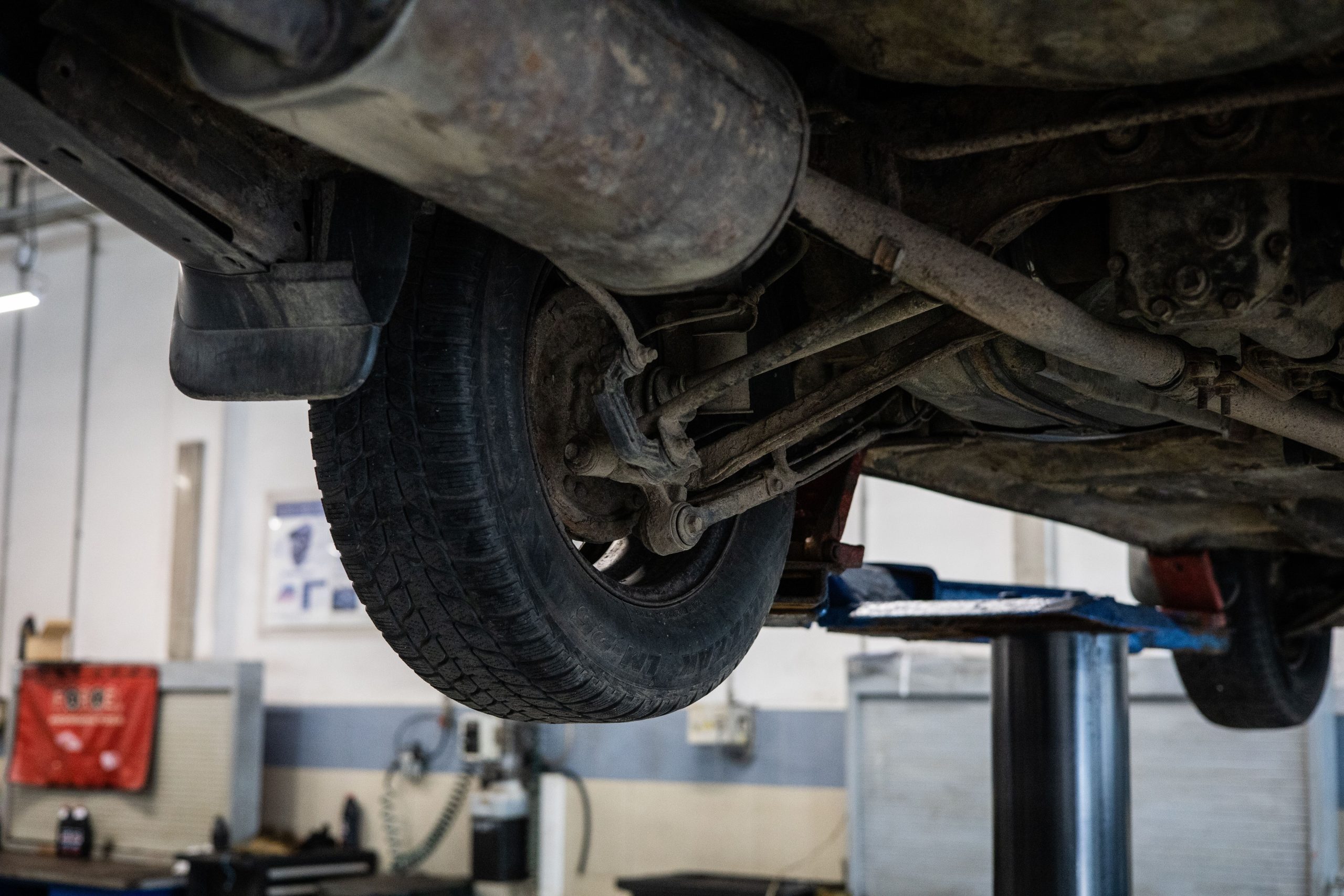
Speed and anonymity are what make this crime attractive compared to almost any other vehicle theft. With a battery-powered reciprocating saw, a thief can cut through the exhaust pipe on either side of the converter and be gone in under two minutes — often before anyone nearby has time to react (Edmunds).
Unlike a stolen car or a stolen catalytic converter’s host vehicle, the part itself typically carries no serial number or identifying mark out of the factory. That anonymity means a stolen converter can be sold to a scrap or recycling buyer with little risk of it being traced back to the theft, which is exactly what keeps the resale pipeline moving.
What Actually Helps Prevent It
- Etch your VIN onto the converter. A visible, permanent VIN etching makes the part traceable and meaningfully less attractive to buyers who don’t want stolen goods with an owner’s name attached.
- Install a physical shield, cage, or clamp. These add real time to the job — often enough that a thief moves on to an easier target instead.
- Park in a garage or well-lit area whenever possible, and consider motion-activated lighting if you park on the street regularly.
- Consider a vehicle alarm sensitive to vibration or tilt, since the physical act of sawing and jacking up a car both trigger detectable movement.
If you own an at-risk vehicle — a high-clearance truck, SUV, or hybrid — these steps matter more than they would on an average sedan, simply because you’re a statistically more attractive target.
Frequently Asked Questions
Does insurance cover a stolen catalytic converter?
Comprehensive coverage typically covers it, since theft falls under comprehensive rather than collision coverage. Check your deductible against the replacement cost — on some vehicles the repair may not clear a high deductible, making the claim not worth filing.
How much does it cost to replace a stolen catalytic converter?
Costs vary widely by vehicle, but replacement — including the part, labor, and often a new section of exhaust pipe — commonly runs several hundred to well over a thousand dollars, more on vehicles with multiple converters or hybrid-specific units.
Can I legally drive after mine is stolen?
You can drive, but it’s not a long-term option. See our guide on driving without a catalytic converter for what changes — louder exhaust, a check engine light, and a failed smog check until it’s replaced.
Do all catalytic converters have equal theft value?
No. Hybrid converters and those on larger or higher-end vehicles generally contain more precious metal and fetch more on the scrap market, which is part of why hybrids like the Prius are disproportionately targeted despite being ordinary passenger cars.
The Bottom Line
Catalytic converter theft comes down to simple economics: the precious metals inside are worth hundreds to over a thousand dollars in scrap, the part takes under two minutes to remove, and it’s nearly impossible to trace once it’s gone. High-clearance trucks and hybrids like the Prius are targeted most, and theft rates track precious metal prices closely enough that a spike in rhodium or palladium prices reliably means a spike in thefts weeks later.
Worried about your vehicle’s risk, or need a stolen converter replaced? Contact San Diego Bumper and Collision for a shield installation or a replacement quote.